Saturday, November 14, 2020

Drunk on Volcanology - Volcano Red Pele's Delight


The next up in our Drunk on Geology series is the Volcano Red Pele's Delight from the Volcano Winery in Volcano, Hawaii. 

The Volcano Winery is in the town of Volcano on the Big Island of Hawaii. The town is just to the north of the main Hawai'i Volcanoes National Park. I had actually done a geological review of the national park earlier which you can find HERE. 

Graphic depiction of the Hawaiian hotspot. Image courtesy of Clark Science.

Many people probably already know this, but the island of Hawai'i is an active volcano. All of the islands of Hawaii are actually volcanoes, with only the Big Island having active volcanoes on it. Hawaii is a special type of volcano known as a hotspot. A hotspot is a type of volcano that sits in one place as the crustal plate on the surface of the Earth rides over it. The source of the magma for a hotspot is an area known as a mantle plume. This spot is essentially "fixed" within the Earth and doesn't move while the plates on the Earth's surface are all moving around on top of it. As the plate moves, the Pacific Plate in this instance, over the hotspot, volcanoes pop up out of the sea floor. As the plate continues to move on, the old volcanoes are pulled away from the hotspot source and die off, while new volcanoes are created. 

The five volcanoes of the Big Island of Hawaii. The red dot denotes the location of the town of Volcano. Immediately below the town you can see a flat circle which is the caldera of the Kilauea volcano. Image courtesy of the USGS. 

The hotspot is currently located on the eastern edge and a bit to the southeast of the Big Island. Off the southeastern shore a new island is actually currently being formed called Lō'ihi. In the future, Lō'ihi has the potential to become a new island or could possibly fuse with the Big Island, like several of the other volcanoes immediately in proximity to each other on the Big Island. On the Big Island there are actually five subaerial volcanoes, of which three are considered active (last erupted in the last 10,000 years): Kilauea, Mauna Loa, and Hualalai. The town of Volcano, where the winery is located, sits on the divide between Mauna Loa and Kilauea. 

My photo of the Kilauea volcano lit up at night from early April of 2018. 

The winery itself is extremely close to the caldera of the Kilauea Volcano. A caldera is a volcanic feature that is kind of like a bowl. As the magma within the volcano erupts, the magma chamber ends up being an empty space within the ground. Frequently this empty space will collapse down upon itself, creating an indented area known as the caldera. The caldera forms around the primary vent or crater, which is the area where the magma leaves the magma chamber to the surface. Once magma erupts onto the surface, it is then considered lava. The Kilauea Caldera had active lava within it when we visited back in April of 2018 within the crater known as Halema'uma'u Crater (seen in the picture above).


Here is the entrance of the Volcano Winery. 


We were staying on the western shore of the Big Island south of Kona. The complex we were staying at had a bunch of lava flows from Hualalai Volcano that flowed out to the ocean that I thought was a perfect backdrop for the wine bottles that we got. 


The Volcano Red depicts some active lava flows dripping into the ocean. Hawaiian lava is a type of lava known as basaltic. Basaltic lava is a fairly high temperature lava with a low silica content. Because of the higher temperatures and low silica content, this type of lava then has a low viscosity, meaning it flows very easily. On the opposite end of the spectrum is felsic lavas which have a high silica content, a lower temperature, and a high viscosity. The high viscosity lavas lead to volcanoes that are steep sided and tend to get plugged up by their own lava flows. These are type of volcanoes most people associate as a volcano, with its stereotypical conical shape. The felsic volcanoes also produce the more explosive eruptions, while the basaltic volcanoes, such as these on Hawaii, are rarely explosive and have a very low profile shape, termed a shield volcano. 


As I noted above here is the text on one side of the label:
"Volcano Winery can be found in the heart of Volcano between Mauna Loa and Kilauea on the Big Island of Hawaii." 
The lava flows that I took the pictures on are a type of basaltic lava flows known as pahoehoe. These are smooth surfaced lava flows that often have a ropey texture. The other type of lava flows are known as a'a', which are very sharp and blocky and not recommended to walk on barefoot.

The other side of the label gives some more background on the wine name:
"The Hawaiians have long honored Pele, fiery goddess of the volcano. Known for her tempestuous, passionate spirit we have created a wine in her honor and call it simply Volcano Red, or Pele's Delight. Blended with grapes and exotic island jaboticaba berries, it boasts ripe black cherry and cranberry notes; then ends with a light, fruity finish to cool her smoldering heart. Imagine what it will do your."

There are quite a few wines available from the winery, but the Volcano Red was the most obvious with the geological connection, but the wines themselves are all very lovely. 

Saturday, November 7, 2020

Drunk on Volcanology - Volcanic Hills Magma Red

The next up in our Drunk on Geology series is the Volcanic Hills Magma Red from the Volcanic Hills Winery. The Volcanic Hills Winery is located in the Okanagan Valley, BC, Canada. 

A lovely wine that we were able to get back in 2017 while we were up in Calgary is the Volcanic Hills Magma Red. British Columbia is rich with volcanoes, most of which are related to subduction along the western coast. This is where one plate goes beneath another plate (the North American plate in this instance) and starts to melt. The melting plate produces volcanoes. This is what is occurring along the western coast of the US with the Cascadian range in Washington and Oregon. However, the volcanic hills are far older than the fairly modern Cascadian volcanoes. The back of the bottle sums up the geology perfectly for the name of the bottle.

"Since 1978 my family and I have been growing grapes in the Okanagan Valley. Our winery is situated on the south eastern slope of a 60 million year old dormant volcano - Boucherie Mountain, which inspired the name "Volcanic Hills". "

The north face of Mount Boucherie. Image courtesy of Stéphane Charette and available on Wikipedia. 

The Okanagan Valley is what is known as a rift valley. This is where essentially the plate starts to tear itself apart. Think of pulling apart some raw dough. As the center area stretches out it starts to get thinner. This thinning of the crust causes the hot mantle down below the crust to come closer to the surface. As the crust gets thinner, the hot mantle is then able to heat up the rocks near the surface, melting them and forming volcanoes. That is what happened in the Okanagan Valley.

Geology of the Okanagan Valley rift zone. Image courtesy of Okanagan Landscape.

Starting ~57 million years ago, the rifting occurred along the Okanagan fault that runs up the center of the valley. Erupting within the valley around 50 million years ago are several volcanoes including Knox Mountain, Dillworth, as well as the afore mentioned Mount Boucherie. Mount Boucherie is a type of volcano known as a stratovolocano. A stratovolcano is a volcano that slowly builds itself up over time with layers of lava flows and ash layers intermixed together. Typically these are more felsic in composition (higher quartz content), meaning that they are more explosive in nature. This remains true for Mount Boucherie, which is mainly composed of rhyolite (a very thick, high silica/quartz content, felsic volcanic rock) and andesite (an intermediate, medium silica/quartz content, volcanic rock). These volcanic rocks formed likely during explosive volcanic eruptions within the area. However, since Mount Boucherie hasn't erupted in several millions of years, and isn't likely to erupt again, it is considered an extinct volcano.

And finishing it off with a lovely shot of the wine bottle with a black bear. I figured that was as Canadian as I could get in the apartment we were staying in at the time. 

References

Sunday, November 1, 2020

Drunk on Mineralogy - Miner's Gold Hefeweizen


The next up on the Drunk on Geology series is Miner's Gold Hefeweizen. Miner's Gold Hefeweizen is produced by the Lewis & Clark Brewing Co. out of Helena, MT. 


Although the beer is clearly named after the golden color of the beer itself, the town of Helena was actually founded by four gold miners from Georgia. So the name is not only in reference to its color but also an homage to Helena's rich gold mining history. 

Starting off with what gold is in general. Gold is one of the unique minerals that, in its pure form, is composed entirely of one element, also call gold, with the symbol Au. It has a hardness of 2.5 to 3 on the Mohs hardness scale meaning that it actually is very soft (your fingernail is 2.5). For this reason most gold jewelry is mixed with another metal to prevent scratching and bending easily. The karat rating of the gold represents it's purity, where 24 karat is 99.9% pure, 22 karat 91.7%, 18 karat 75%, and so on. Gold naturally does not corrode or tarnish, so even when it is mixed with other metals it usually has a resistance to tarnishing, enhancing its value for jewelry. 


When gold is found in place, the highest grade of gold is often found in association with quartz veins. Currently gold is considered one of the most valuable metals on Earth, being used as the standard for most money (gold standard). Gold is often formed initially in relation to volcanic regions, where hydrothermal fluids associated with volcanoes carry the heavy metals up towards the surface and deposit them in rocks. These are found in areas of current or former subduction zones, places where two plates came together forcing one place down and melting it, while the other plate is forced upwards into mountains. Afterwards, erosion will take the gold out of the mountains and carry them down stream. However, since gold is so dense it does not travel easily down rivers and will often settle to the bottom of the river within the rocks and mud within the river sediment. These gold deposits are known as placer deposits and are the primary place where gold panners find gold. They can then use the locations of these placer deposits to backtrack to the original sources of the gold within the streams. 

Mining towns of Montana. Image courtesy of RareGoldNuggets.com.

Gold deposits are found all over Montana, but primarily along the more mountainous southwestern part of the state, as seen in the image above. Gold had first been discovered in 1862 in Montana and eventually in 1864, the four Georgians had made their way to the Helena area to look for gold. The miners were unlucky in other areas, however their last try was at a claim they named the "Last Chance Gulch". The Last Chance Gulch ended up a winner, supplying more than $19 million worth of gold over four years. Last Chance Gulch actually falls now within the city limits of Helena and many of the placer deposits that were found were found during excavation of the town itself.


The gold from Helena and nearby Butte both come from the formation of the Boulder Batholith. The Boulder Batholith is a small batholith on the scale of batholiths, but a major gold producer. In general, a batholith is a very large rock that formed from a magma body deep within the Earth. The Boulder Batholith, named after the boulders that occur as the rock breaks down on the surface, is a large granite body that formed from an igneous intrusion 76 million years ago. The intrusion of the magma produced a hydrothermal system, heating up the groundwater and melting the metallic minerals within the area rocks, including the granite. These metallic minerals, now mobile within the water, were then reprecipitated within the older sedimentary and metamorphic rocks of the area surrounding the granite, producing rick metallic ore veins in conjunction with quartz veins. Not only are these Boulder Batholith related rocks rich in gold, but nearby Butte has one of the richest copper producing zones in the world. 

References

Saturday, October 10, 2020

Drunk on Seismology - Liquefaction Red IPA


The next up in the Drunk on Geology series is Liquefaction Red IPA, the 2016 Geological Society of America specialty label by Left Hand Brewing. Left Hand Brewing was also responsible for the Field Assistant Ale specialty label from the 2013 GSA Annual Meeting. 


Like the Field Assistant Ale, this label is designed by Moxie Sozo and features a couple of geologists in a field vehicle that happened to get inundated within some liquefied sediment. A more complete view of the label can be seen below in the sticker that was given away at the meeting.

The back label

Liquefaction is the process where normally solid sediment can start acting like a liquid when shaken. This can cause multiple things to happen including shaking the ground like Jell-O, or even buildings getting swallowed up within the sediment, like quicksand. Normally, particles in the sediment, are tightly packed. However, during an earthquake, the sediments start to shake and vibrate. As they move about, the spacing between the sediment particles increases. As the spacing increases, the ability for the sediment to act like a liquid increases.

Wednesday, September 9, 2020

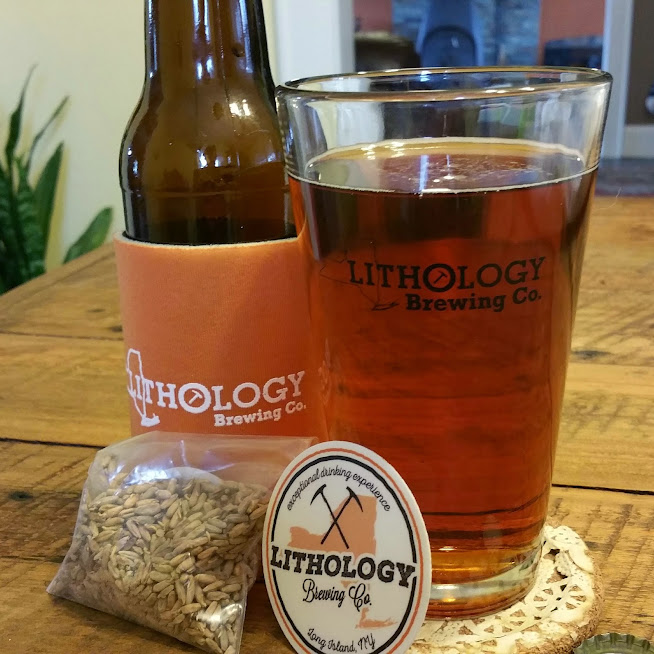
Drunk on Petrology - Lithology Brewing Company


The next up on the Drunk on Geology series is a whole company, the Lithology Brewing Company from Long Island, New York.

 
This is a unique entry because:
  1. I haven't actually purchased any myself and I prefer to do that before I post about it (just so I can post my own photos), and 
  2. This started off as a Kickstarter Campaign some time ago that I wrote about on my other geology site: The Geology P.A.G.E. I have since removed all of the Drunk on Geology posts off that page and moved them to their new home here. And since this is the last post that needs to be moved, I figured I would redo the post now that it is an established brewery.  

Tuesday, September 8, 2020

Drunk on Meteorology - Inversion IPA


The next up in the Drunk on Geology series is Inversion IPA  produced by Deschutes Brewery from Bend, Oregon.

A nice beer to calm all paranoia about what the inversion is doing to my lungs.

So what exactly is an "inversion". People from Utah more than likely know what it is, even if they don't know the cause of it. People from outside the state may not be as familiar with it, although it does occur in other regions with similar topography (valley surrounded by mountains). 

Monday, September 7, 2020

Drunk on Meteorology - The Logo

 The next logo, and the last new one for a little bit, is:

 Drunk on Meteorology


To go with the drinking theme, we have a hurricane glass as our focal point and a tornado coming down from the hurricane thunderhead clouds into the glass. We also have some rock hammery lightning from the clouds.